

Complete Guide to Uninterruptible Power Supply
The current digital age has been marked with great use of computers in homes, offices, school and business. Whether carrying out critical documents, servers, playing games or conducting business, there is a possibility of loss of data, hardware destruction and even loss of productivity in case of an unexpected power loss. At this stage, a UPS (Uninterruptible Power Supply) is needed.
UPS is not merely a battery back-up device, or even a power protection system, but a UPS is a System of Power Protection, which is created to make sure that your personal computer is safe through an electrical shock. In this step-by-step guide, we would explain what a UPS is, how it works, the types of it, the benefits, the components of its construction, and how to choose the suitable one to your computer.
________________________________________
What Is a UPS?
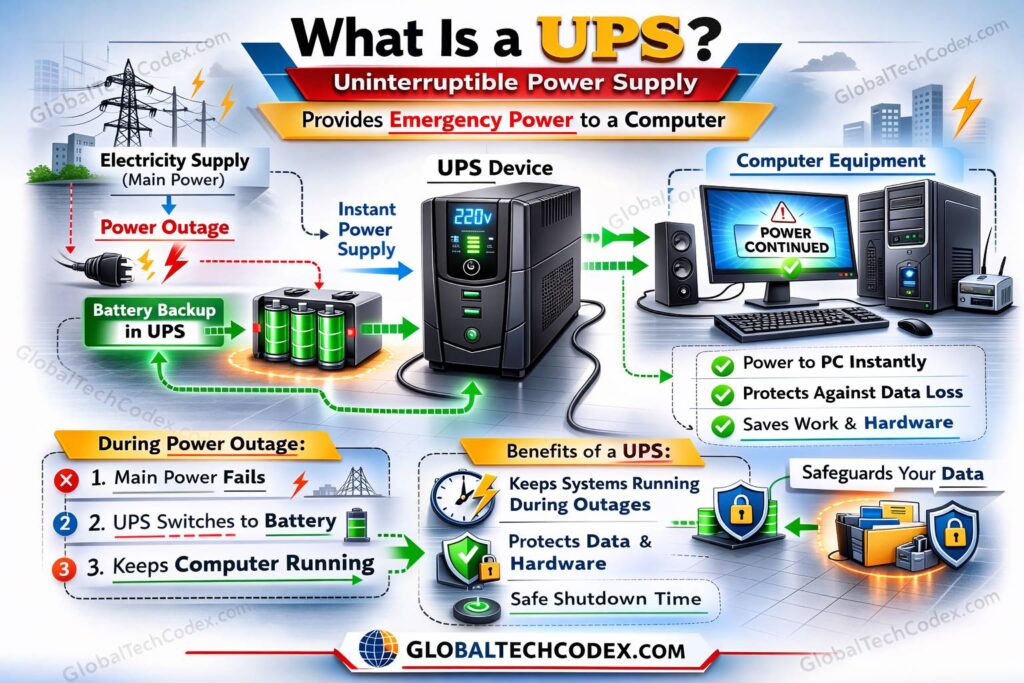
A UPS (Uninterruptible Power Supply) is a device, which is used to supply emergency power to a computer or any other equipment in case the main power supply is no longer accessible. It also protects equipment against power problems such as power spikes and surges, dips, and swings.
Compared to a generator, which may require a considerable amount of time to start, a UPS is an instant source of power a built-in battery. This will ensure that your computer does not crash unwillingly before you can save your work and close it.
In simple terms:
in case of a power failure that occurs the UPS will change to battery and the computer will still remain running temporarily.
________________________________________
What Is the significance of UPS in computers?
Computers are sensitive electronic devices. Sudden power loss can cause:
- Data corruption
- Loss of unsaved work
- Hard drive damage
- System crashes
- Reduced hardware lifespan
A UPS precurs such issues by:
- Giving you time to save files
- Allowing safe shutdown
- Electrical destruction of components insulated.
- Stabilizing voltage supply
A UPS is more significant in the scenario of a business since a business can lose money and becomes inconvenienced in the event of outage.
________________________________________
How Does a UPS Work?
One of the UPS monitors the entry of electricity in the power supply at all times. It also includes a battery that can be charged on an ordinary supply of electricity.
Should there be a loss or gain in power:
1. The UPS detects the issue.
2. It switches off automatically to battery mode.
3. It holds power generated to the connected devices.
4. Once it receives electricity again, it powers up and recharges the battery once again.
Switching process takes place in milliseconds therefore the computer is not switched off.
________________________________________
Main Components of a UPS
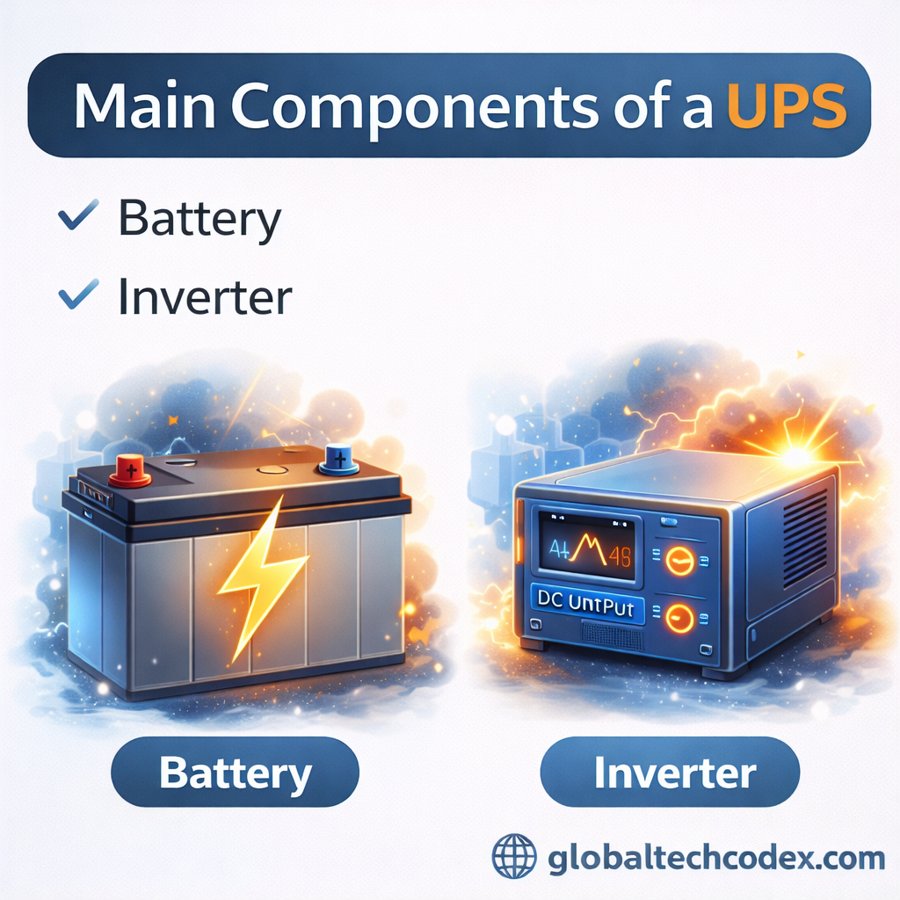
There are several significant components to the UPS system:
1. Battery
Electric power is stored in the battery and it provides a backup power in case of an outage.
2. Inverter
Converts the battery DC to AC (Alternating Current) which is consumed by computers.
3. Rectifier/Charger
plugs into the primary power, recharges the battery.
4. Transfer Switch
Auto-on / off main power/battery.
5. Surge Protection Circuit
Lowers voltage spike and surges.
These sections are incorporated in ensuring the power supply at any given time is constant and always stable.
________________________________________
Types of UPS for Computers
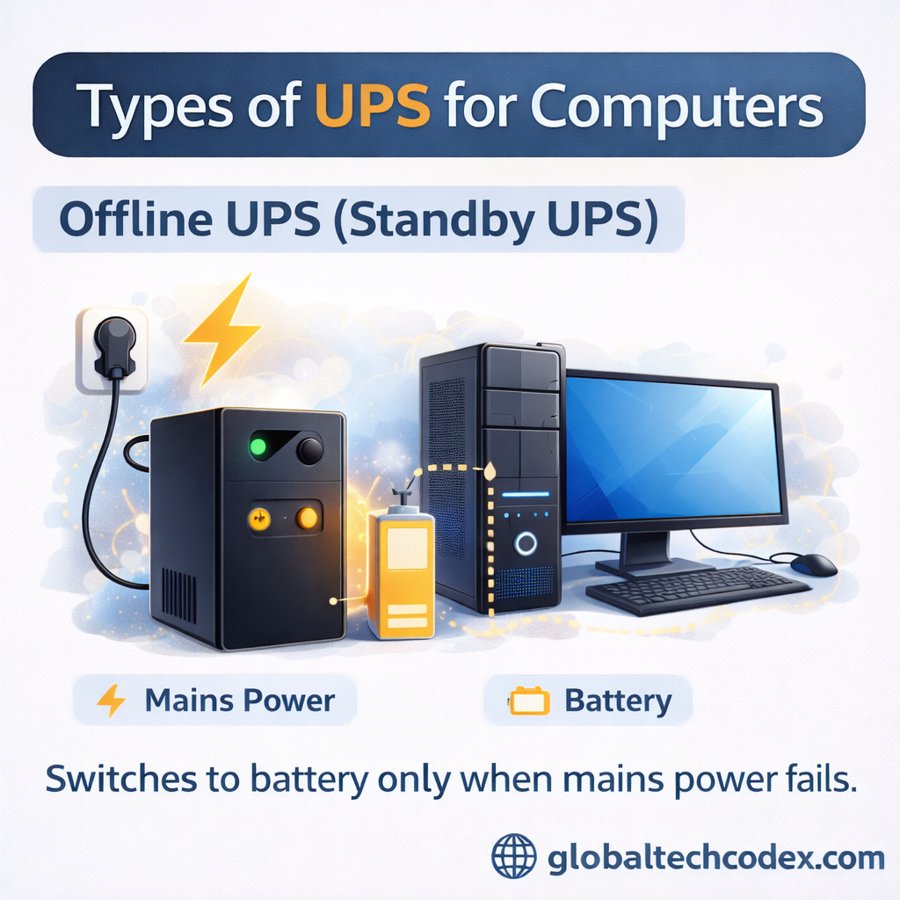
There are three types of UPS systems:
1. Offline UPS (Standby UPS)
It is the less expensive and the easiest one.
Most of the mains supplies power when the machine is operating under normal conditions.
On loss of power, switches to battery.
• Adapts to the small offices and home computers.
Pros:
• Low cost
• Compact size
Cons:
• Slight switching delay
• Limited power conditioning
________________________________________
2. Line-Interactive UPS
This type is more advanced.
• Automatic regulation of the voltage variability.
• had an automatic voltage regulation (AVR).
More suitable to locations with large power fluctuations.
Pros:
• Improved voltage stability
• Longer battery life
Cons:
Weaknesses Costly versus offline UPS.
________________________________________
3. On-line UPS ( Double conversion UPS).
It is the largest developed type.
Alternates AC and DC and the reverse.
• Provides reliable and clean power supply at all times.
• No switching delay.
Pros:
• Highest protection level
Cons:
• Higher cost
• Larger size
A line interactive UPS is usually adequate to home users. Online UPS can be of interest to companies that have servers.
________________________________________
How Long Does a UPS Last?
Backup time depends on:
• Battery capacity
• Load connected
• UPS rating (VA/Watt)
For example:
A small desktop PC can support a 600 VA UPS which can offer 5 to 10 minutes.
A bigger 1500VA UPS is capable of delivering up to 15-30 minutes.
This is usually supposed to allow a safe shut down and not to waste the computer hours.
UPS Capacity: VA Watts consciousness.
These UPS systems are of the VA (Volt-Amperes) and otherwise in Watts.
• VA measures apparent power.
Power used is actual power.
To choose the right UPS:
1. Added monitor power consumption and power of other devices.
2. Choose UPS in which the capacity is 20 -30 percent of the load.
Example:
Next, suppose that you have a 400 watts system, and a 600-800VA UPS.
________________________________________
The benefits of UPS Usage in a Computer.
1. Power failure insurance.
Cripples your system during your downtimes.
2. Prevents Data Loss
Allows system security and seal off.
3. Surge Protection
Spikes guard equipment.
4. Voltage Regulation
Has stable voltage supply.
5. Prolongs Hardware life.
Reduces the impact of influence that is not stable.
________________________________________
Maintenance Tips for UPS
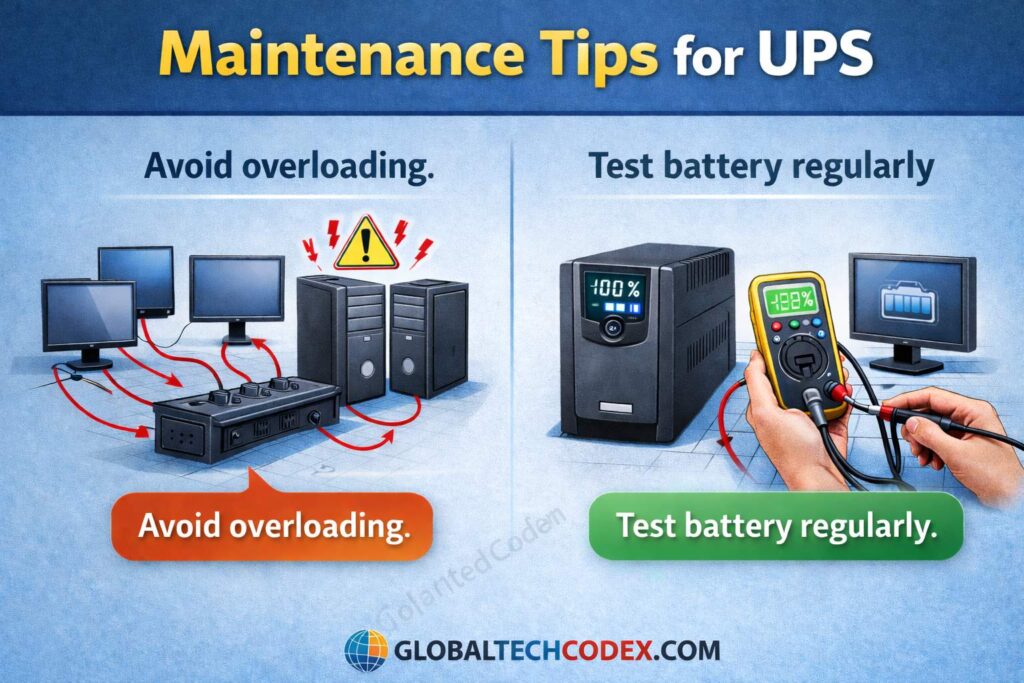
The performance is pegged on the long life and performance of the performance:
Store UPS in a well-ventilated location.
• Avoid overloading.
• Test battery regularly.
• Replace battery every 3–5 years.
High power appliances like the heaters and printers should be avoided.
Maintenance is also done periodically in an effort to ensure that in case of emergency, the system would remain dependable.
________________________________________
Signs of the replacement of the UPS.
• Battery not holding charge
• Frequent alarms
• Reduced backup time
• Battery physical swelling.
• UPS not switching properly
Should such problems be noticed, then it might be necessary to replace the battery, or change unit.
________________________________________
Who Should Use a UPS?
A UPS is ideal for:
Home users Desktop computers.
• Gamers
• Remote workers
• Small businesses
• Server rooms
• Medical equipment setups
• CCTV systems
A UPS can be utilized by any user who has its dependence on electronic gadgets.
________________________________________
Being able to choose the UPS to your computer.
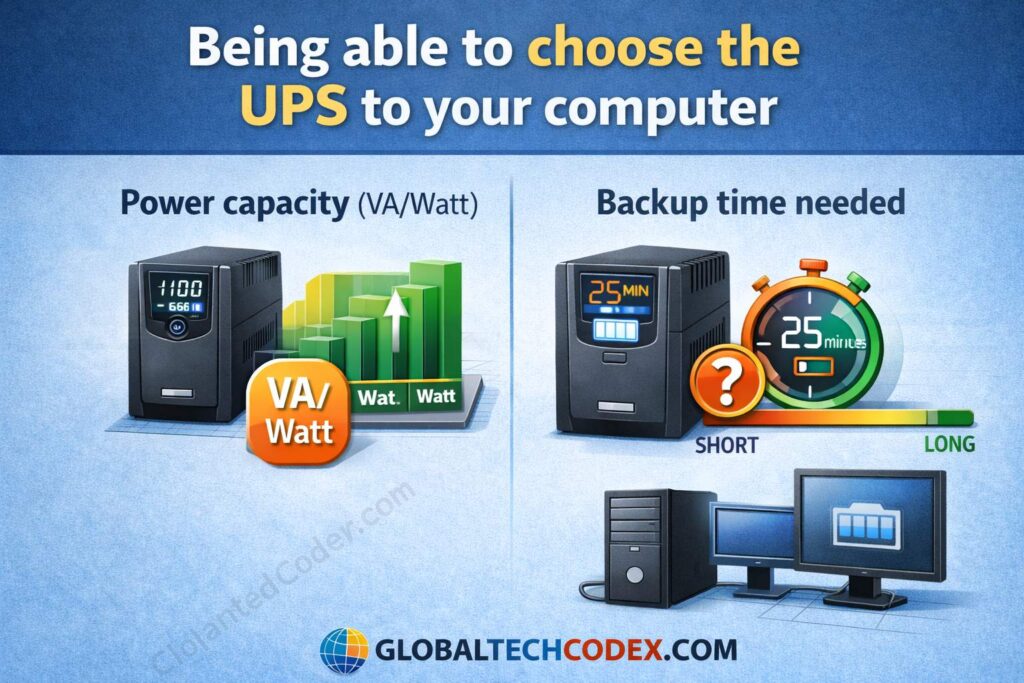
When buying a UPS, consider:
• Power capacity (VA/Watt)
• Backup time needed
• Type of UPS
• Number of output sockets
• Brand reliability
• Battery replacement cost
• Warranty
Basic home applications can be made using a typical 600-1000VA line-interactive UPS.
The case of servers or work environment would recommend an online UPS.
________________________________________
Conclusion
A computer has not only a backup battery, but also a full power protective system, a UPS to or in. It saves your data and safeguards expensive appliances and unrelenting performance during power outburst.
The UPS is not a choice but a necessity in the regions where the electricity supply is not quite steady. You are either a student or employee or you are a player or an entrepreneur and have an establishment that is dependable on UPS is what will ensure that you will not lose without some reason or you will not suffer because something has been broken somewhere where it is costly.
With the best UPS, which will depend on your power needs, you will be assured of the peace and security of your equipment even at the long run. The gold is the digital data and the power security cannot be left behind in the world with its pure gold.