
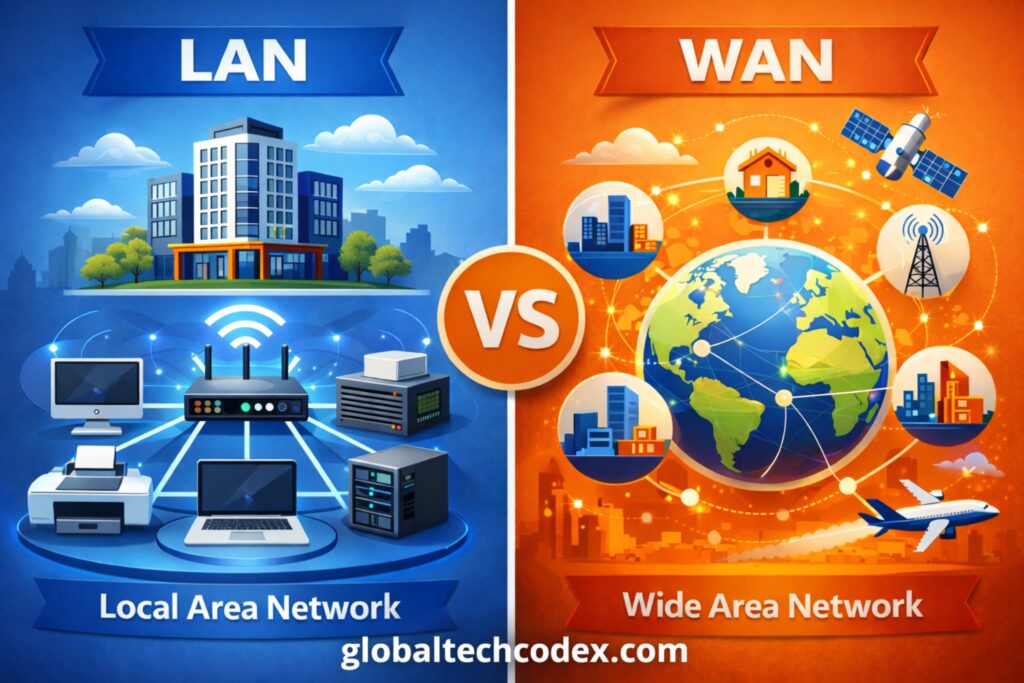

In the modern world, computer networks play a significant role in communication since the devices can exchange information and resources efficiently. Some of the most common types of networks are Local Area Networks(LAN) and Wide Area Networks(WAN). The two systems of networks vary in size, speed, cost as well as purpose albeit the fact that both networks are required in the connection among people and gadgets throughout the world.
The awareness of the distinction between LAN and WAN enables people and companies to take the proper action of approach to network solution whenever they are required to use one. The paper discusses the meaning of LAN and WLAN, how it works, the advantages and disadvantages of it, and the significant distinction between the two.
What is Local Area Network (LAN)?
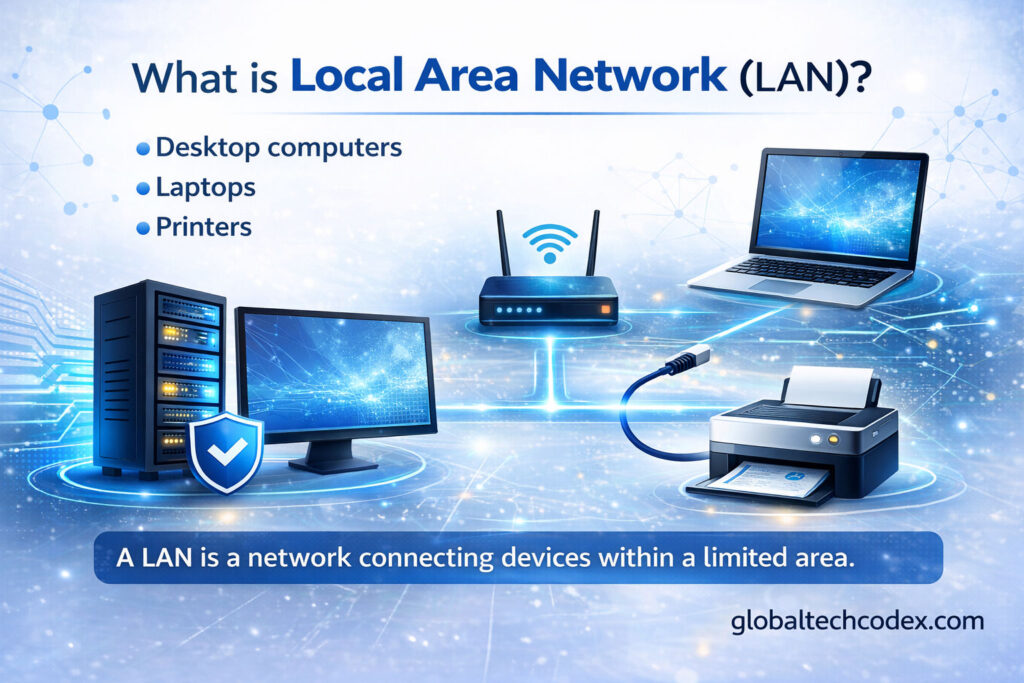
Local Area Network (LAN) is a network that interconnects computers and devices within a limited geographical area such as a house, school, office or a building. LANS are supposed to provide fast and convenient communication between the devices which are close to each other.
A typical LAN has such devices as:
• Desktop computers
• Laptops
• Printers
• Routers
• Switches
• Smartphones
• Smart TVs
LANs are operated usually using Ethernet or wifi connections. LANs are applied in most of the home networks and office networks.
An example of this is the use of a LAN where a group of computers is linked to a common printer in a given office or where they have access to files in a server.
Characteristics of LAN
LANs have a number of characteristic characteristics:
1. Limited Geographic Area
LANs are small in terms of their area that can be a building or a campus.
2. High Speed
LANs are extremely fast in data transfer rate ranging between 100mbps and 10 Gbps among others.
3. Low Latency
The devices are so near and hence data travels very quick with little or no delay.
4. Private Ownership
LANS are owned and maintained by persons or organizations.
5. Easy Maintenance
Large networks are also difficult to install and manage as compared to LANs.
Advantages of LAN

There are several strengths of LANs:
Fast Communication
LAN devices can share information in a fast manner and file sharing is efficient.
Resource Sharing
Users can share printers, storage devices as well as the software applications.
Cost-Effective
LANs are not expensive to run and install.
Improved Collaboration
Employees or students can also work together by sharing of files and information.
Better Security Control
The security measures can be applied since the LANs are privately controlled and the administrators are therefore, in a position to apply security measures.
Disadvantages of LAN
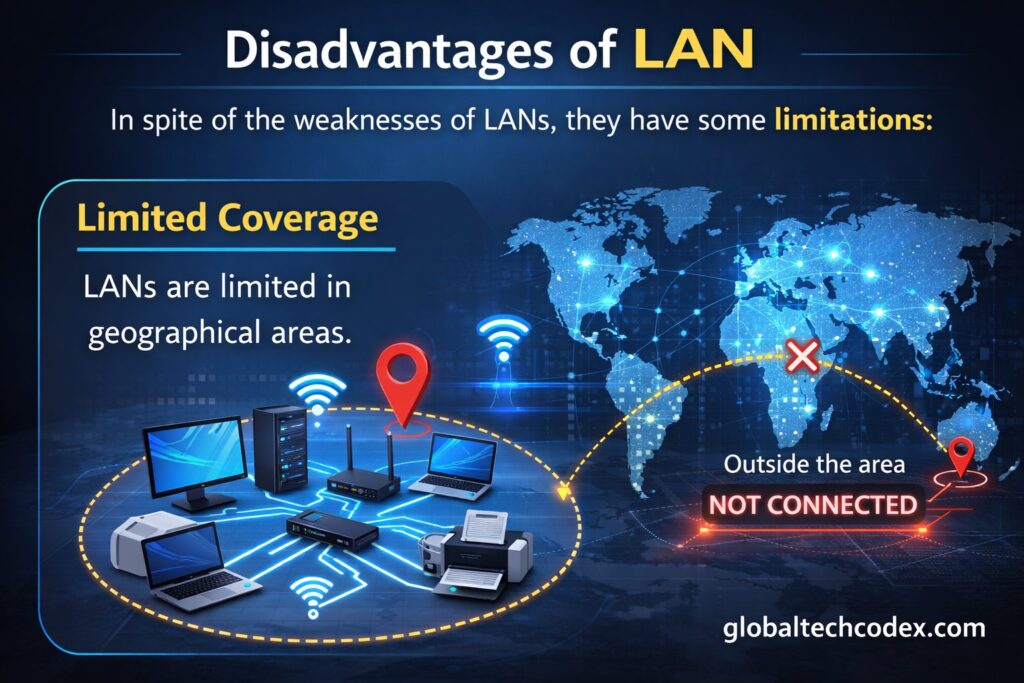
In spite of the weaknesses of LANs, they have some limitations:
Limited Coverage
LANs are limited in geographical areas.
Initial Setup Cost
Installation of network equipments and cables is time consuming and expensive.
Maintenance Required
LANs are supposed to be maintained and monitored.
Network Failures
The network may also go to a grinding halt, just in case the central server or the router fails.
What is WAN (Wide Area Network)?
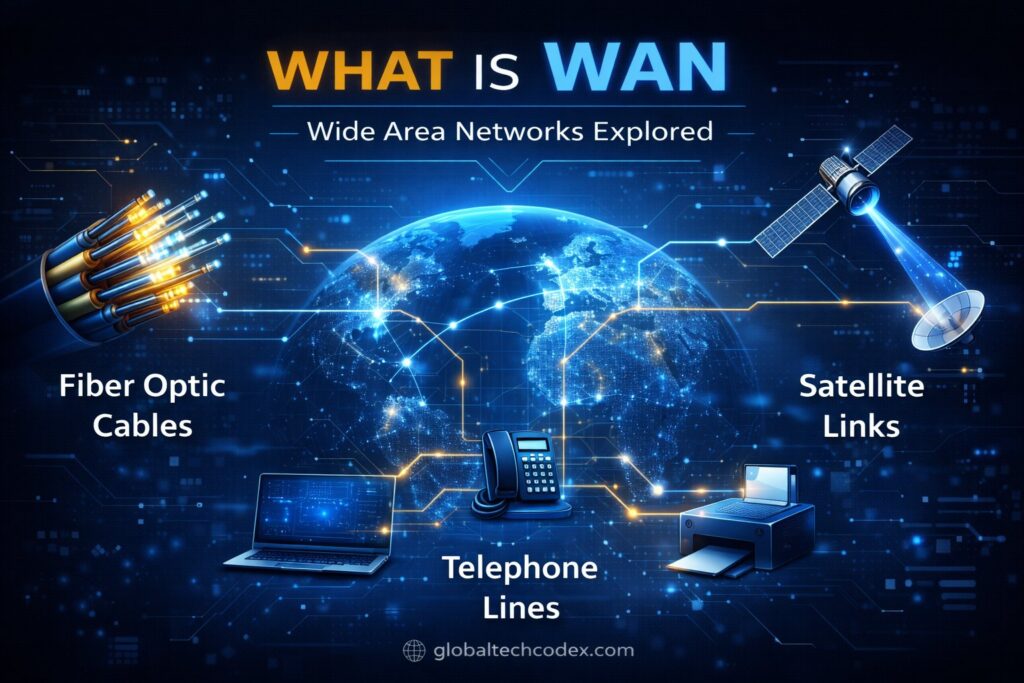
Wide Area Network (WAN) is a kind of a network that connects computers and devices that have very wide geographical area such as that of a city, country or even continent. WANs have the capability of communicating between two or more LANs.
Internet is the most popular WAN. It connects millions of LANs worldwide rendering it a world-wide communication.
WANs use various communication technology such as:
• Fiber optic cables
• Telephone lines
• Satellite links
• Cellular networks
• Wireless transmission
Organizations with multi branches that have different branch offices in different places are often inclined to employ the use of WANs to make a connection between the offices.
To provide an example, a company with offices in different cities can interconnect the offices using a WAN to encourage information and communication sharing among the employees.
Characteristics of WAN
The WANS are differentiated in the unique characteristics when compared to LANs.
1. Large Geographic Coverage
WANs are expansive in area to country or the entire world.
2. Lower Speed Compared to LAN
WANs tend to be very slow as compared to LANs, as the data is transmitted over a greater distance.
3. Higher Latency
The distances are longer hence more time is utilized in data transmission.
4. Multiple Ownership
WAN infrastructure is traditionally maintained by service providers.
5. Complex Structure
WANs are overwhelming and they consume immense number of devices and technologies.
Advantages of WAN

Global Connectivity
Long distance communication is achieved through WANs.
Centralized Data Access
Companies can centralize the data and enable a person to access it at different locations.
Remote Work Support
With the WAN connections, workers can work anywhere.
Business Expansion
Organisations can connect offices in other cities or countries.
Access to Internet Services
Cloud platforms and online services are available to WANs.
Disadvantages of WAN
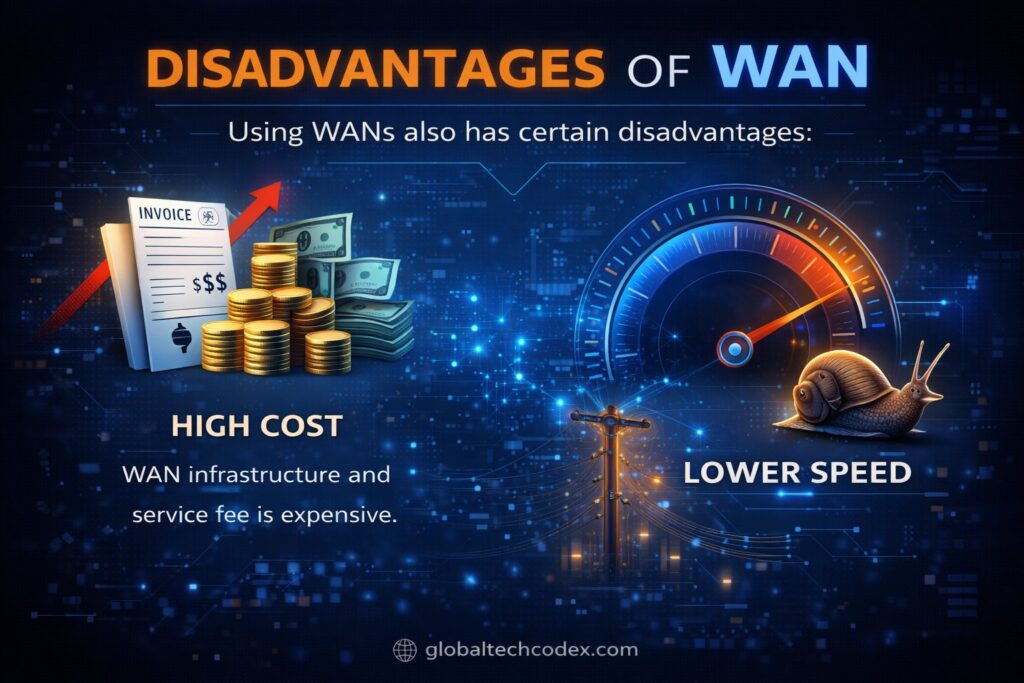
Using WANs also has certain disadvantages:
High Cost
WAN infrastructure and service fee is expensive.
Lower Speed
The transfer speed of data is mostly low when compared to LAN.
Security Risks
WANs are subject to cyber attacks.
Complex Setup
Installation of WAN and maintenance requires technical expertise.
Dependence on Service Providers.
WAN in organisations is connected through internet service providers.
Major and Major Differences between LAN and WAN.
LAN and WAN are different in a number of ways.
1. Geographic Coverage
The key distinction between LAN and WAN is the area of coverage.
LAN is small like a home, office, or campus. WAN encompasses many regions including cities, countries or continents.
2. Speed
LAN networks are more expensive as compared to WAN networks since devices are near to each other.
WAN networks are slower as it requires longer distances.
3. Cost
LAN networks are less expensive to setup and maintain.
WAN networks are costlier in terms of cost of infrastructure and service costs.
4. Ownership
LAN networks are typically the property of individuals or organizations privately.
It is common to have several service providers of WAN networks.
5. Security
LAN networks are usually more secure as they are limited to access.
Public access increases security risk to WAN networks.
6. Setup Complexity
Installation of LAN is not that difficult.
WAN implementation is more complex and it needs sophisticated networking devices.
Examples of LAN and WAN
Examples of LAN
• Home Wi-Fi network
• School computer lab
• Office network
• Library network
• Small business network
Examples of WAN
• The Internet
• Branch to branch networks within a bank.
• Reservation systems in airlines.
• International intra-corporate networks.
• Mobile networks
How LAN and WAN Work Together
LAN and WAN are frequently used to produce entire networking systems.
A company office is an example where a LAN is used to interlink computers in the building. The LAN is then linked to a WAN to enable the employees to communicate with other offices and be able to access the Internet.
Likewise, home network will be a LAN that is linked to the Internet via WAN link that is offered by an Internet service provider.
This is a combination that enables local and international communication.
LAN and WAN Modern Developments.
The LAN and WAN networks are still being enhanced by technology.
Faster LAN Technologies
The LANs today are equipped with high speed Ethernet and advanced Wi-Fi standards that offer greater speed of connection. Multi-gigabits and gigabit speeds are being realized in both homes and offices.
Cloud Networking
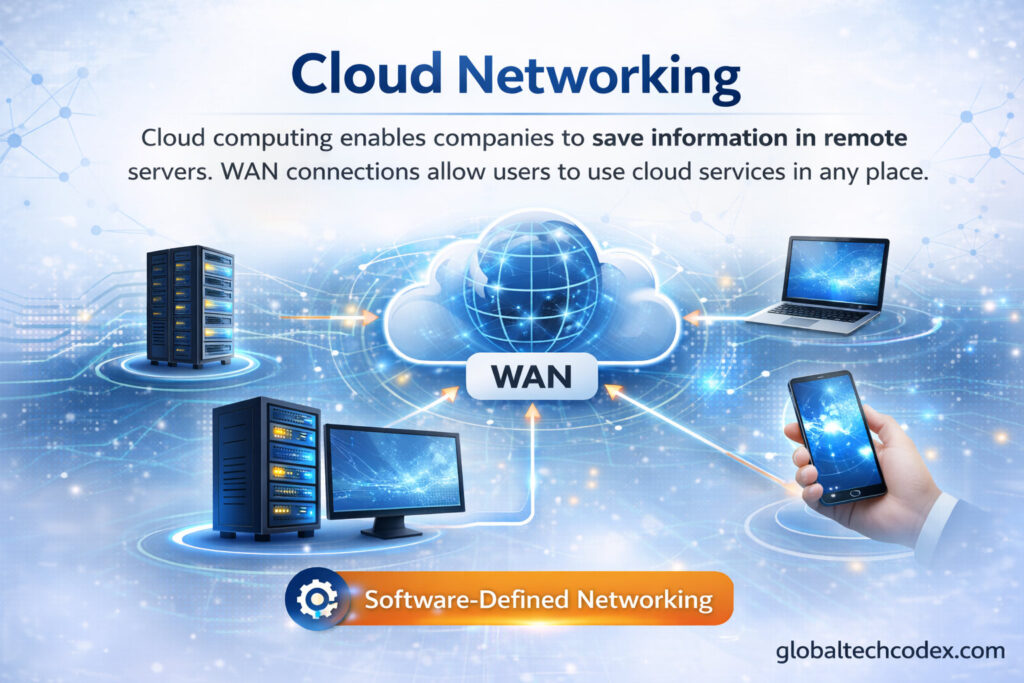
Cloud computing enables companies to save information in remote servers. WAN connections allow users to use cloud services in any place.
Software-Defined Networking
Software-defined networking SDN is a network that can be controlled by software rather than hardware controls in place of software control by the administrator.
5G and Wireless WAN
The wireless WAN is also being enhanced by the 5G technology that offers a high speed and reduces the latency.
These are causing networks to be more efficient and open.
Choosing Between LAN and WAN
Access to LAN or WAN is determined by the need.
A LAN is suitable when:
The devices are under one building.
• High speed is required
• Costs must be low
• Sharing of resources locally is required.
A WAN is suitable when:
Devices are in various different cities or countries.
• Remote access is required
• There has to be connectivity between business branches.
• Internet access is needed
In the majority of organizations, both LAN and WAN are utilized.
Conclusion
LAN and WAN are the basic elements of networking in the modern world. LAN is used to connect devices in a small locality and offer a speedy and dependable communication. WAN links networks over a wide radius and thus can be used to communicate internationally.
Although LAN is fast, easy and less expensive, WAN is very broad and has the ability to be connected remotely. LAN and WAN are two elements that constitute the backbone of the current communication systems.
Knowledge of what is the difference between LAN and WAN will assist users to make decisions on the design and management of networks. The role of LAN and WAN in communication of the digital world will remain critical as technology keeps on advancing.