


The past 20 years has seen the software development being dynamic and many platforms have brought this change. One of the most influential development platforms that Microsoft has presented is the.NET Framework. It has done much in developing windows based software products and it has been mainstream in the business environment.
The .NET Framework provides the developers with a systematic model of programming, massive reusable libraries and a runtime environment that facilitate the process of creating sophisticated applications. Nevertheless, even with newer versions of .NET, the .NET Framework has gained relevance in the fact that most of the large organizations are still using systems built on the platform.
In a pragmatic way of developing the architecture, life cycles of development, technologies and its use in enterprise software, the paper has discussed the creation of the applications of the .NET Framework.
Understanding the Intention of the .Net Framework.
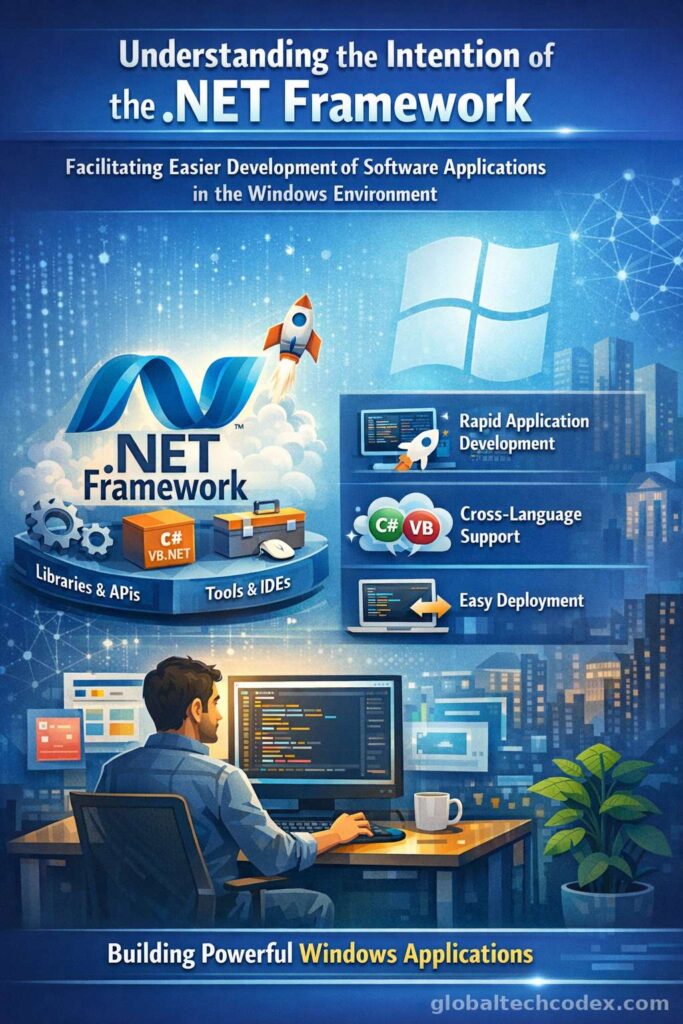
The primary reason why the .NET Framework exists is to facilitate easier development of software applications in the windows environment. The developers develop applications on an environment which is provided by a framework, rather than address the operating system or the hardware resources directly.
This is a controlled setting and it has tools and libraries that accommodate the regular programming operations such as file handling, networking, database communications, user interface development and security. The developers can therefore focus more on application logic rather than addressing the complexity of the system at the low level.
The other major characteristic of the framework is that it provides inter-application consistency. The developers possess standardized structure that gives them ease in the maintenance of the large projects and collaboration with other team members.
The Managed Execution Environment.
The managed model of execution is one of the features of the creation of the application on the basis of the .NET Framework. In this model, the applications are run in a controlled runtime environment unlike when they are run on the operating system.
Any code written by the developers in any language supported by the framework is then converted into the intermediate form as opposed to native machine instructions. The compilation of this code is contained in assemblies that are the program instructions and metadata compiled files.
When the system is in operation, it converts the intermediate code to machine level code that could be executed on the computer. This process allows the runtime to monitor the behaviour of the application and provides services such as memory allocation, security verification and error handling.
Controlled execution environment plays a significant role in improving stability of the applications because the runtime system can automatically detect and correct a significant number of problems.
Designing a .Net Framework Application.
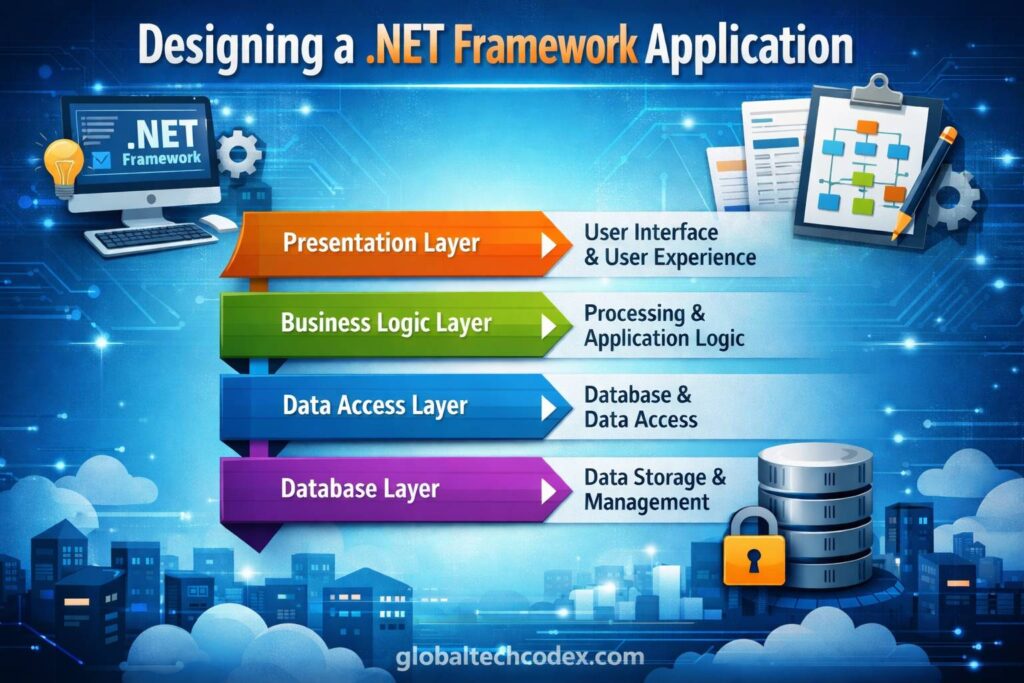
The programs that are developed on the basis of the .NET Framework are traditionally stratified. The layers possess some responsibility in the software system.
Presentation Layer
This layer handles the aspect of information presentation and receiving user input.
The technologies which are used normally in this layer include:
Windows Forms
Windows presentation foundation (WPF).
ASP.NET Web Forms
These technologies permit the user to develop graphical interfaces, manage user interaction, as well as binding UI elements to the underlying application logic.
Business Logic Layer
The regulations and functions that dictate the application behavior are stored in the business logic layer. It receives the input of the presentation layer and calculates, validates and processes the data.
The separation of business logic and user interface increases the maintainability of the application and also makes the application develop without changing other components of the system.
Data Access Layer
The data access layer will be concerned with databases or external storage systems. It extracts information, modernises records and does transactions.
The communication technologies that exist in the databases include:
ADO.NET
Entity Framework
LINQ to SQL
Since the database operations can be split apart using an independent layer, developers can make alterations to the database structures, or can switch to alternate storage systems without having much of an impact on the remainder of the components.
.NET Framework based Projects Workflow Development.
With the .NET Framework the construction of an application will be built on a formal workflow.
The initial process entails the definition of the project form and the kind of application to be selected. The developers then design the user interface and determine the architecture of the application.
The next one is that of business logic components and then that of database integration. Testing is carried out throughout in the development process, to ensure that all parts are functional.
Once the application is complete, it is bundled down into assemblies and installed into the target environment in which the environment has been installed with the.NET Framework runtime.
Integrated Development Environment.
One of the factors that made development of .NET Framework to be a common practice was powerful development tools.
Microsoft Visual Studio is the main integrated development environment that has been utilized in developing.NET. It provides productivity augmenting features and simplifying the difficult program writing.
The available tools to the developers include:
Smart code completion.
Advanced debugging systems
Graphical interface designers.
Integrated version control
Profiling, and testing utilities.
The features enable the developers to create, test and implement applications better.
Database System and Data Processing.
Most software systems have data management as a basic need. The .NET Framework offers a number of technologies that can help the developers to operate with databases effectively.
One of the data access technologies is ADO.NET.
With this technology, developers are able to create connections, make queries as well as retrieve data into the memory to be processed.
Subsequent technologies like Entity Framework offered a concept of object-relational mapping that enabled the developers to interface with databases in terms of object-oriented programming as opposed to writing complex SQL statements.
The abstraction makes database development easier and minimizes the repetitive code.
Security Mechanisms in Framework.

Enterprise applications vulnerability to security is a fundamental issue and the .NET Framework has several features which provide application and data security.
Systems of authentication can be applied in the applications that authenticate the identity of the user and then allow access. Mechanisms of authorization require users to have limited access to only features or data that their position allows.
The framework also offers encryption libraries that can be used in securing sensitive information when storing and transmitting the same.
The other essential security measure is controlled code verification. The runtime performs code validation before executing it to verify that it is safe programming code. This avoids some form of malicious or bad behavior.
Enterprise Use Cases
There are numerous industries that are based on systems that are based on .NET Framework. The applications are usually volumes of transactions and must be very reliable.
The framework is applied in the banking industry to create a system of transaction management and internal tools. It is used by healthcare organizations to manage the records of the patients, booking of appointments and billing.
The manufacturing businesses develop the software to monitor the production, and supply chain management solutions are developed by the logistics companies.
These enterprise systems can run over several years hence the reason why the .NET Framework is still maintained and supported.
Maintenance and Modernization of Applications.

Technology changes often create organizations which upgrade or modernize their existing applications. A large number of legacy systems developed using the .NET Framework are being transitioned to the current-day .NET systems.
Modernization can include restructuring the application architecture, performance enhancement, and software modifications to operate in the cloud.
Full migration is not, however, always necessary. Most companies keep their existing applications in the.NET Framework and combine them with new services through the modern technologies.
Such an environment especially requires developers that are conversant with both the traditional and modern .NET ecosystems.
Software Developers Importance.
The development of .NET Framework offers a number of advantages to future software engineers.
First, it exposes the developers to the systematic design of enterprise applications. Layered architecture, separation of concerns and reusable components are some of the concepts that are popularly used in a wide variety of programming platforms.
Second, the awareness of the framework aids developers in the maintenance and enhancement of the existing enterprise systems that are still being used by the organizations.
Third, having worked with the .NET Framework it is simpler to upgrade to current .NET platforms since much of the concepts are still alike.
Moreover, developers have a chance to be educated in real life about Windows based software development, database combination, and mass management of applications.
Future Outlook

Despite the fact that Microsoft is still investing in new .NET environments, the .NET Framework will still be pertinent in those companies that have the long-standing software systems.
Businesses are not quick to overhaul huge software complexes. Rather, systems change over time and most of the systems are still running on stable platforms such as the .NET Framework.
This is why skills in the old and new.NET technologies will be sought after even many years ahead.
Conclusion
The software development world has been forever impacted by The .NET Framework. It also allowed developers to develop reliable programs based on Windows with high level of efficiency by offering a managed execution environment, huge libraries, and high level development tools.
The framework has underpinned millions of applications in industries, both at desktop and at enterprise business systems. Although modern. NET platforms keep evolving, the original ideas proposed by the. NET Framework are still very relevant.
The concept of .NET Framework application development is essential to assist developers to maintain the available systems as well as provide a solid background in learning the current technologies in the Microsoft development. It is a significant technology to study to any person who has an interest in the development of enterprise software.