


The Backbone of Modern Web Application Software development is the discipline in which the new web applications extensively make use of a backend system. The backend facilitates the processing of the information, processing of business logic, authentication and communication to the databases as user gets to interact with graphically attractive user interfaces on the front side. The Web Application Engine is one of the critical components of the backend architecture.
A Web based application is done by a Web Application engine that is the central system that manages and executes the primary portion of the application. It deciphers requests at the user end, runs code at the server end, interacts with databases and returns an answer to the customer. In the absence of this engine, the web applications would not have been able to perform dynamic operations because they contain complicated workflows.
This paper will discuss the term web application engine, its functionality, architecture, major components, its benefits and its contribution to the current development of the modern backend applications.
What is Web Application Engine?
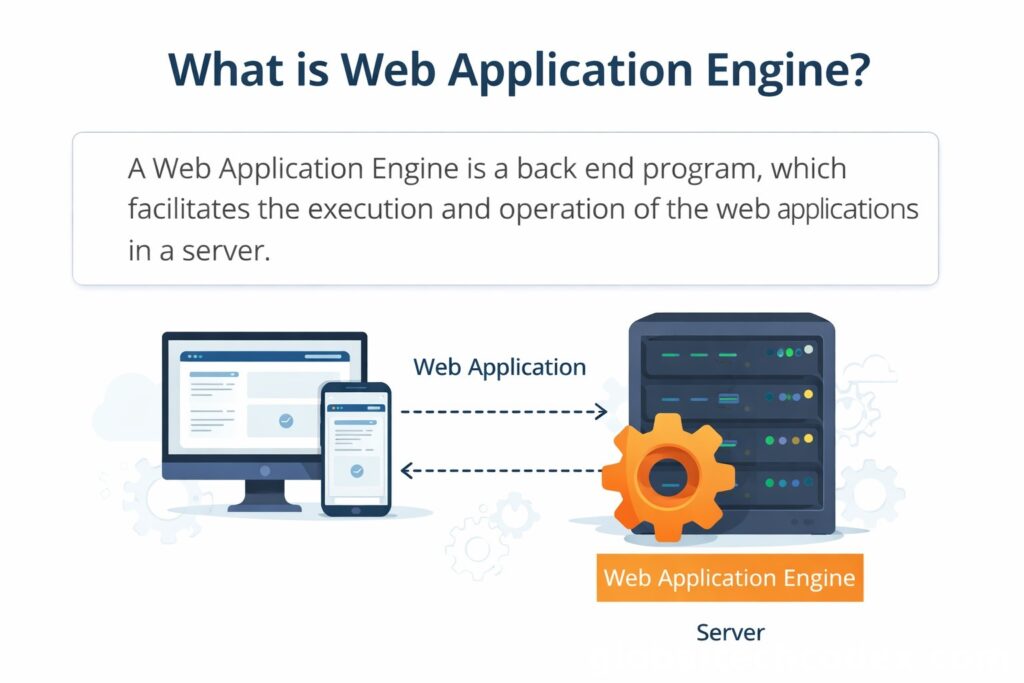
A Web Application Engine is a back end program, which facilitates the execution and operation of the web applications in a server. It receives and services the incoming HTTP requests, runs application codes, communicates with databases or other services, and response is to be sent to the browser of the user.
The web application engine is just the brain of a web application. It determines the manner in which the application will act in relation to the needs of the user and the logic which is present.
At a site, in an example, a request is posted to a server which contains the web application engine that is used to check the credentials against a stored data in a database. This would then lead to a response of giving the user to his/her account access when the credentials are valid.
Some of the popular web applications engines and web application frameworks include node.js, Django, Ruby on rails, Spring boot and Asp.net. The technologies furnish developers with the tools and the environment to make the backend systems be scaled effectively.
Serviceability of Web Application Engine.
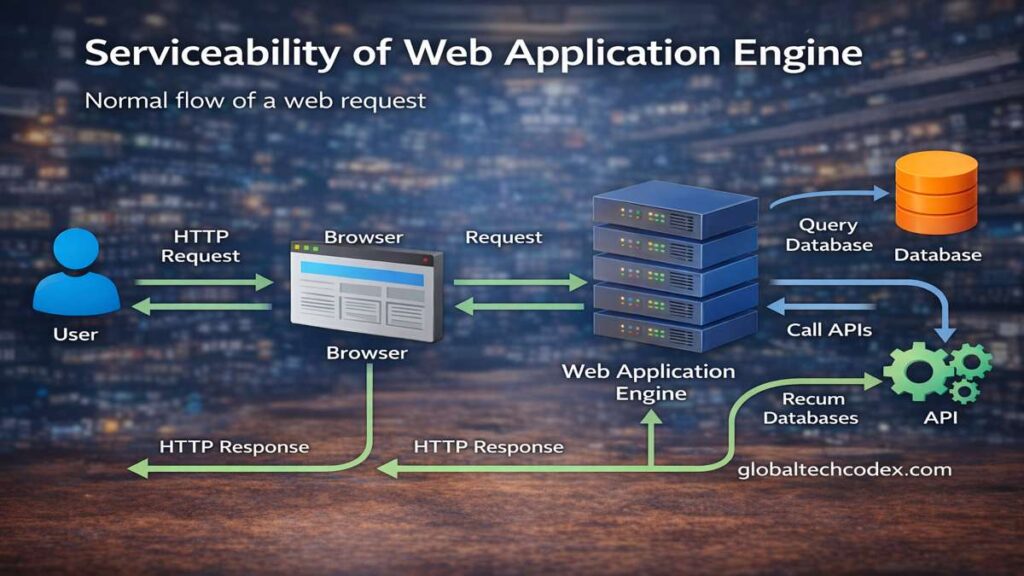
In order to get a clear picture of how a web application engine works, it would thus be interesting to see the normal flow of a web request.
The browser of a user sends a request to the server when he/she opens a site or opens a web application using a HTTP or a HTTPS protocol. Such request could be form then data, log in, search query or API request.
This request is sent to the engine of the web server which in turn remits the request to the web application engine. The engine will then enforce the request on the backend logic that can be any of the language including JavaScript, Python, Java, PHP, or C#.
The engine can fulfill a number of tasks in this procedure:
- Validate user input
- Authenticate users
- Read or write database attenuation.
- Execute business logic
- Interact with external APIs.
An engine is generated in response to the request on processing the request. This response will be in HTML or it can be in a JSON or XML format or any other format depending on the way the application is configured. The server then bounces back the response to the browser of the user.
The browser takes out the response and presents the result to a user.
Web Application Engineering Architecture.
A web application engine is typically built on a multi-layered platform, a platform designed in such a manner that will guarantee scalability, maintainability and performance. The most common one is the triple-layered one.
The presentation layer is referred to as the user interface. Even though this layer is part of the frontend it is directly linked to the backend engine via requests and response.
The business logic is found in the application layer. This is where the rule execution, the workflow execution and reaction as to how the application works takes place in the web application engine.
Data layer Data retrieval and data storage. It contains databases, caching services and data management services.
Such layered architecture allows the separation of the concerns and allows the developers, to which every of the concerns may be scaled and maintained.
The key Building Blocks of a Web Application Engine.
A contemporary web application engine comprises of various significant components that interact with one another in order to receive requests and deliver application services.
The request handler is one of such components. It accepts the incoming HTTP requests and forwards them to the respective section of the application. The routing systems define what requests should be serviced by what function or controller.
The other component is middleware system. The middleware interposes between the response and the request. It is able to execute authentication, logging, request validation and error management processes.
This is done at the controller layer that is application logic processing. Routing system asks the controllers and accepts them performing the functions which communicate with the models and services.
The application data structure is displayed as the model layer. Data storage, access and manipulation in the system is through models.
Lastly, database connector helps the application engine to interact with the database. It is one of the factors which enable the backend to save the user data, reconsider the data and update the records.
A combination of all these dimensions is an organized environment that facilitates effective and credible back-end operations.
Famous Web application Engines/Frameworks.
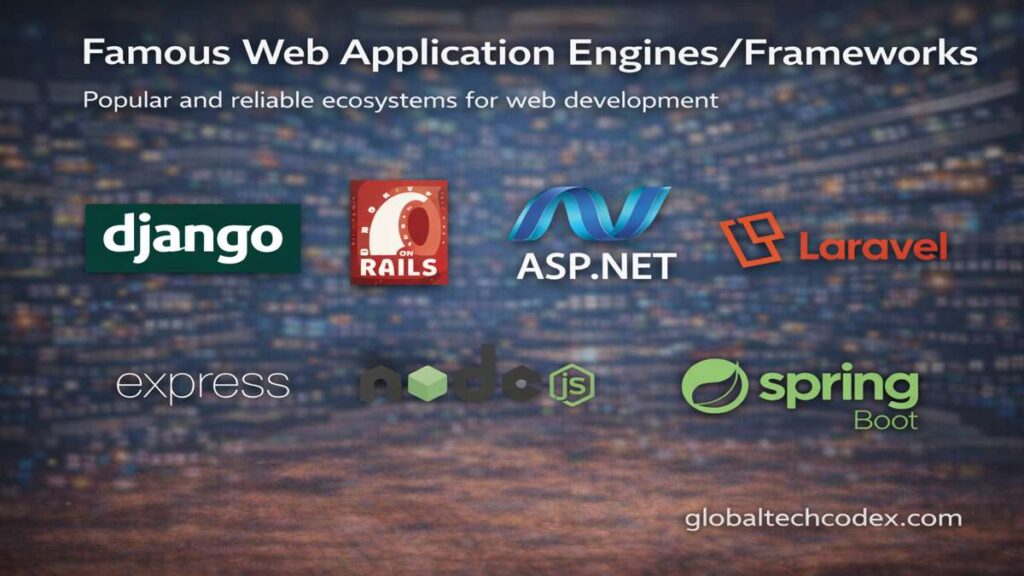
Some of the engines built on web applications have gained popularity among the software developers due to their reliability and good ecosystems.
The node.js is a JavaScript environment, it allows the developer to write scalable applications in JavaScript as the server. It is highly adopted as one of the real time applications in the case of chat system and collaboration tools.
Django is a high-level Python Web framework and is defined by simplicity and security. It follows the Model-View-Template architecture and has significant functionalities that are inbuilt to enable a rapid development.
Ruby on Rails is yet another framework that is quite powerful, as it is convention-driven, as opposed to configuration. It may facilitate the process of development through provision of templates of structures and tools.
Application on the enterprise level is where JAVA Spring boot is very extensively used. It provides strong features of making safe and scalable backend services.
ASP.NET is a Microsoft technology which is used in web application development in the current times using CSharp and the platform of the.NET.
The two technologies can be termed as a web application engine to manage the application processes and the logic applied to them.
Talking of the strengths of Using a Web Application Engine.
Web applications engines possess several benefits that guarantee the efficiency and reliability of the backend development.
The most important advantage is scalability. The modern web engines are configured in a manner that they are capable of supporting thousands or even millions of users at the same time by distributing the work loads to the servers.
The other advantage is modularity. It is also easy to maintain and update the applications because the developers can organize code into reusable parts.
Efforts on security are also enhanced with engine web applications which have inbuilt protection against many of the common vulnerabilities such as cross-site scripting (XSS), SQL injection as well as cross-site request forgery (CSRF).
Another one is that they improve the growth rate. Most of the frameworks have libraries, tools as well as templates that allow the developers to create applications faster without triggering the development of a new application.
Web Application Engines in New Applications Role.
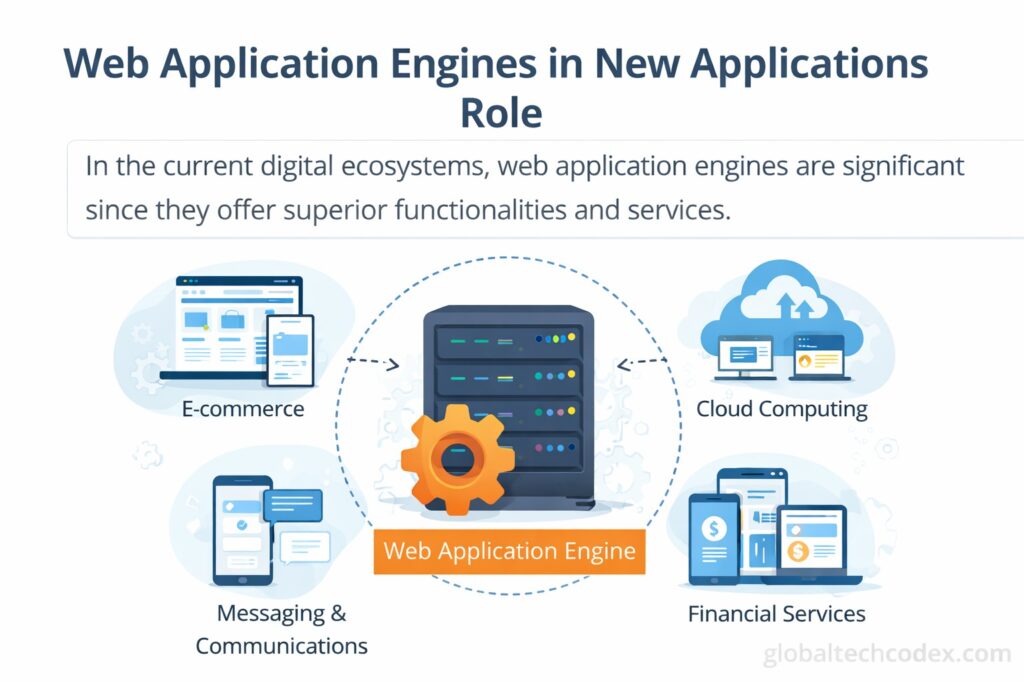
In the current digital ecosystems, web application engines are significant since they offer superior functionalities and services.
They run e-commerce websites, which include the lists of the products, clients, money-taking system, and order management.
They encourage the use of social media sites on which profile, user posts, messages and real-time updates are processed.
They are also in favour of cloud based software applications, such as project management applications, learning and team building systems on the Internet.
To maintain the performance and consistency of these applications, the web application engines are used in data processing, system integration, and security control.
Web Application Engineering Design Best Practices.
Best practices applicable when developers are developing web application engine based backend systems are many.
One of the practices is clean and modular code architecture. This makes application scaling and maintenance much easier.
The other metric is implementing efficient error handling and logging systems. These help the developers to identify and correct the issues within a short period.
Security is one more parameter that should be taken into account. The developers will be to confirm the input of the users, safe maintenance of sensitive data and secure authentication.
It is as well significant as performance optimization. Some of the techniques include caching, load balancing and asynchronous processing which can go far in the process of improving the effectiveness of the system.
Finally, the developer should use automated testing to ensure that the features of the applications are predictable and working.
Predicting the Future of Web Application Engines.

The future of web application engines can be associated with the progress of cloud computing, microservice architecture, and serverless technologies.
Modern applications currently have a trend that is moving towards microservices, and different components of the system are being implemented as autonomous services that communicate through APIs. This plan allows scaling of systems.
Services such as cloud function services allow the developer to execute code that is executed on the backend without server management.
There is also an increase in the use of artificial intelligence and with it the backend systems can perform more sophisticated functions such as recommendation systems, predictive analytics and natural language processing.
As these technologies are still in their formation the web application engines will continue to feature significantly in the development of the back-end and the digital infrastructure.
Conclusion
The Web Application Engine is one of the core components of the backend development. It is the engine of web applications, it receives requests, does logic and acts upon data and refers to users.
The web application engines can also enable the developer to develop scalability, efficient and secure applications, by providing structured environments to control the server-side operations. Most of the modern internet, which includes the advanced cloud-based platforms, is powered by these engines.